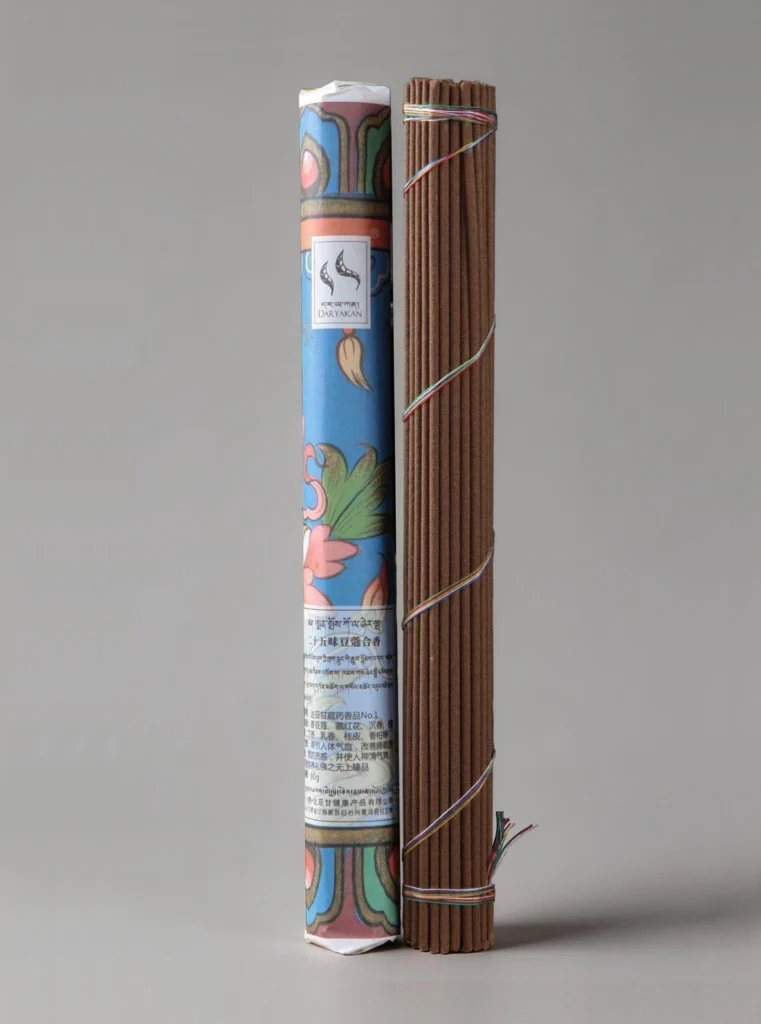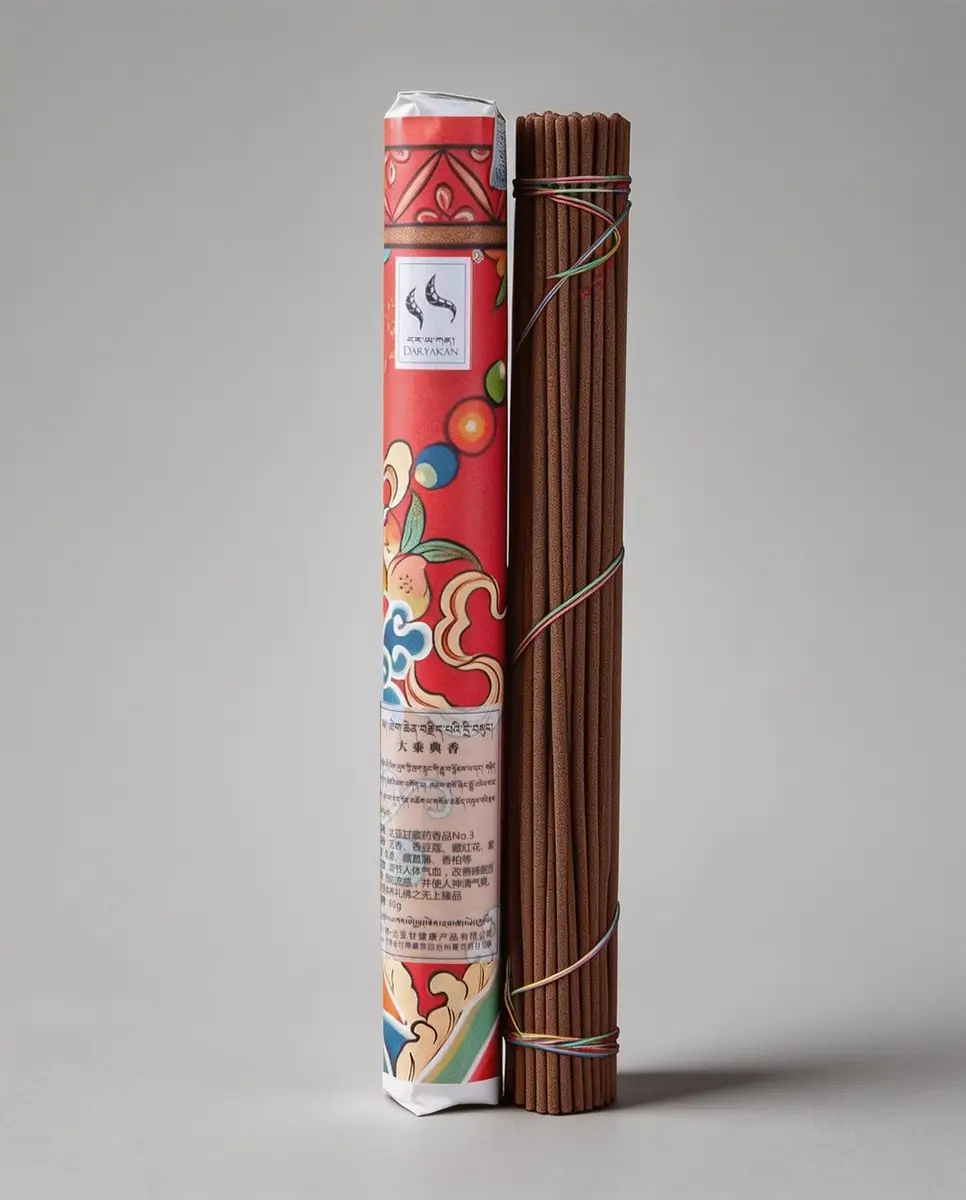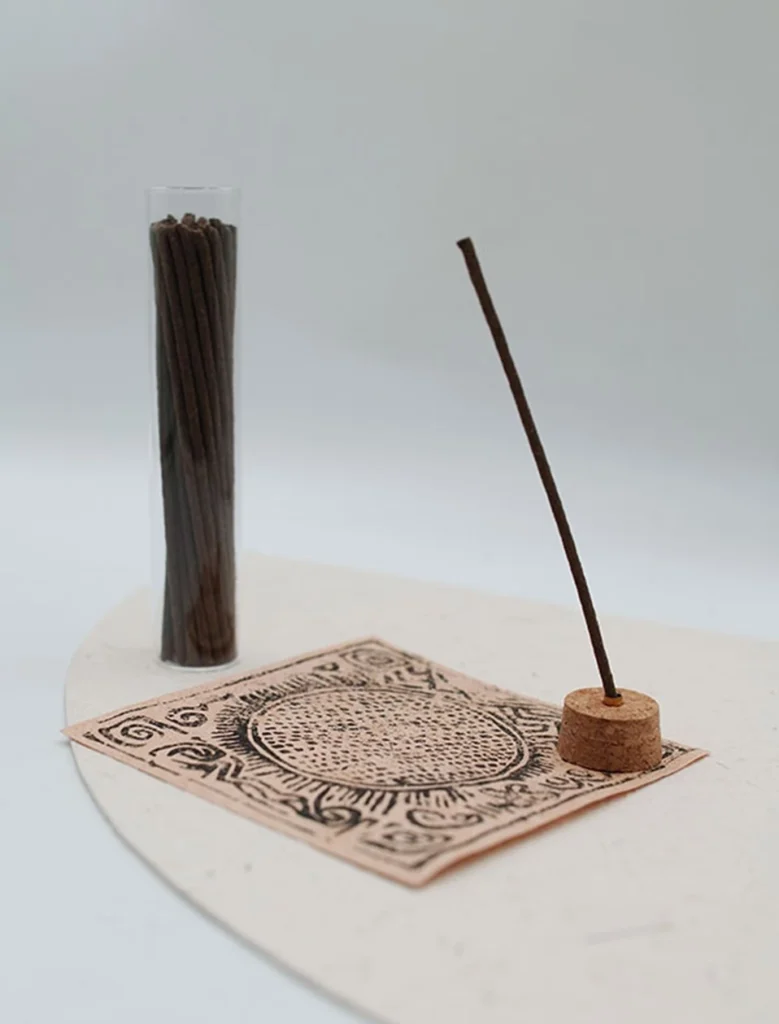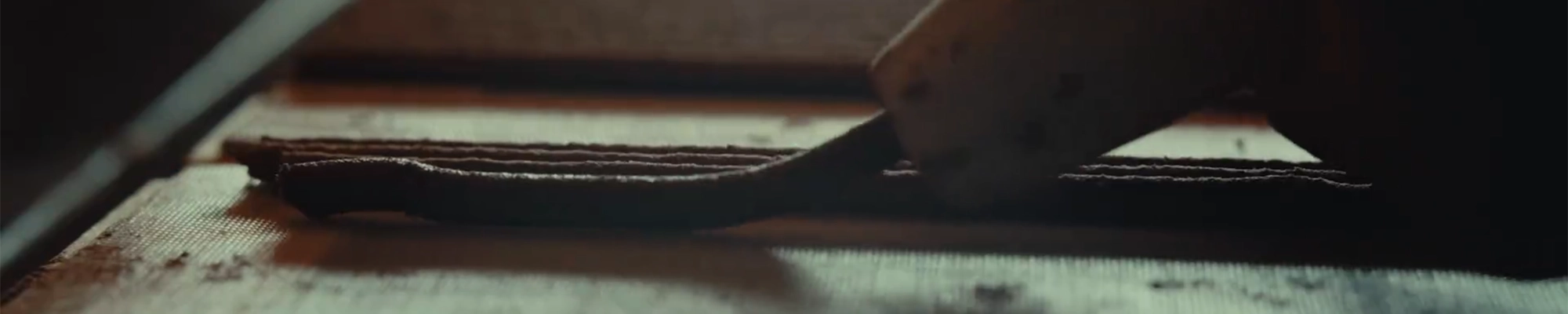
Tibetan incense is a Himalayan form of incense made without a bamboo core. Rather than being wrapped around a stick, it is extruded into strips with specific tools, hand-pressed into cones or just powdered. Deeply rooted in Buddhist and Tibetan medical traditions, it is widely prevalent throughout Tibet, Nepal, India, Bhutan, and other Himalayan regions.
Key takeaways
- Tibetan incense is usually bamboo-core-free and shaped as extruded sticks or hand-pressed cones.
- Its formulas commonly combine Himalayan cypress with aromatic and Precious Himalayan herbal medicines.
- Its scent profile is often medicinal, herbaceous, warm, and smoky.
- In Buddhist ritual, incense is a significant offering and a material part of practice.
What Is Tibetan Incense?
According to historical records, Tibetan incense has been passed down for over 1,300 years. In the 7th century, Songtsen Gampo dispatched 16 young scholars to India for study, 15 of whom perished abroad, leaving only Tonmi Sambhoṭa to return. Legend has it that Tibetan incense was developed and propagated by this great scholar, who was born in Nyemo Tunba.
Tibetan incense stands as a significant emblem of Tibetan culture. In every monastery across Tibet, one can detect the solemn and familiar fragrance unique to that sacred place.
How Is Tibetan Incense Made?
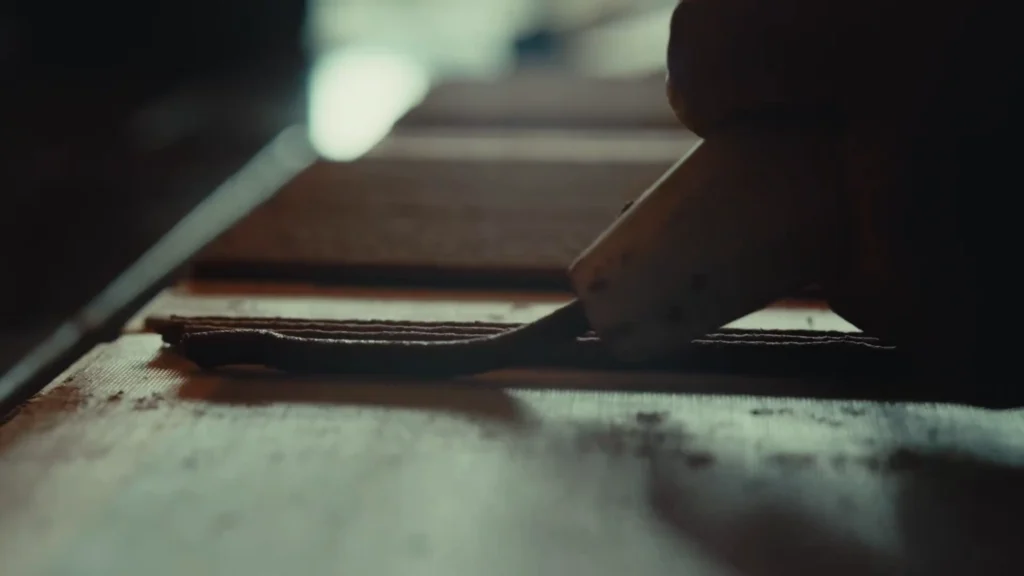
These time-honoured formulas determine that the composition of traditionally crafted Tibetan incense typically includes a variety of Precious Himalayan herbal medicines. Mainstream Tibetan incense generally uses Himalayan cypress wood as a base, to which sandalwood, saffron, benzoin, nutmeg, clove, cardamom, and amomum are added in fixed proportions, all kneaded together without any synthetic fragrances. The proportion and treatment of each ingredient are governed by strict standards.
Composition, Efficacy, and Appreciation of Tibetan Incense
Tibetan incense constitutes a branch of the Tibetan medical system. Inspired by the research of his predecessors and through his own unremitting practice, the great Tibetan physician Yutok Yönten Gönpo authored the monumental medical work The Four Medical Tantras (rgyud bzhi), which provides detailed accounts of therapies, pharmaceuticals, formulas, and the preparation, raw materials, processing techniques, and efficacy of Tibetan incense. In particular, it analyses the fumigation and topical application of various aromatic medicinal plants, giving rise to the “fumigation therapy” widely adopted in later Tibetan medical practice. The medicinal value of Tibetan incense was gradually unearthed and came to be highly regarded.
In the 18th century, the Tibetan physician Deumar Geshé Tendzin Püntsok, in his classic pharmacological treatises Shel gong (Crystal Globe) and Shel phreng (Crystal Rosary), also recorded the formulas and manufacturing methods of incense from Nyemo and other regions. From the perspective of Tibetan medicine, he further defined and characterised the mineral, botanical, and medicinal raw materials used in incense-making, thereby more clearly establishing its therapeutic significance.
According to these traditional Tibetan medical texts, when incense is burned indoors, its fragrance permeates the air and penetrates through the skin and joints. It not only purifies the air and moisturises the skin but also enhances disease resistance, prevents joint pain, regulates skin conditions, alleviates mental stress, soothes the mind, reduces nervous headaches, and improves sleep quality. Long-term users of Tibetan incense often retain its distinctive subtle fragrance on their bodies for extended periods.
What Does Tibetan Incense Smell Like?
Tibetan incense generally imparts a medicinal and herbaceous character.
Take Labrang Monastery Mahayana Tibetan Incense as an example: upon lighting, the cypress aroma blazes a trail, soon enveloping the senses in the deep warmth of agarwood. A fleeting hint of acridness from Tibetan calamus gives way to the sweetness of cardamom, while frankincense lingers like a haunting refrain, evoking an exotic, smoky ambience.
Other Tibetan incenses offer different aromatic experiences because their formulas differ.

How Is Tibetan Incense Used in Buddhist Ritual Contexts?
In Buddhism, whether as an offering to the Buddhas and Bodhisattvas or as a metaphor in sermons, incense is frequently invoked for its significance, virtue, and spiritual efficacy. As a vital article of offering, incense shares an inseparable bond with Buddhism. Presenting incense to the Buddha or scriptural texts carries profound meaning and accrues great merit.
The Susiddhikara Sūtra enumerates five kinds of offerings to the principal deity: fragrant unguents, flower garlands, burnt incense, food, and lamps—incense being listed as one of the five. Burnt incense also constitutes an essential offering in Esoteric Buddhism, where it joins arghya (ritual water), fragrant unguents, flower garlands, lamps, and food to form the six offerings. In Zen monasteries, burning incense is referred to as “taking up the incense” or “placing a stick of incense.” During Dharma assemblies, the monk who holds the incense container is known as the “incense-burning attendant.”
The Vairocanābhisaṃbodhi Sutra (vol. 8) states that burnt incense signifies pervasion throughout the Dharma-realm—just as the celestial king of trees, when in full bloom, scatters its fragrance naturally both against and with the wind, so too does every virtue, when kindled by the fire of wisdom and wafted by the wind of liberation, universally perfume all things. The Chang ahan jing (Youxing jing) (vol. 2) records that a layperson, having erected a great hall for the Tathāgata, would tidy the premises, sprinkle them with pure water, and burn incense. The Larger Sutra on Amitāyus (vol. 2) likewise instructs practitioners to hang banners, light lamps, scatter flowers, and burn incense, dedicating such merits toward rebirth in the Land of Ultimate Bliss.
In Esoteric ritual, whereas round pellets of incense symbolise gathered afflictions in their totality, fragmented incense represents subtle and scattered defilements; during the ceremony, both are cast into the fire altar and consumed as offerings. Unlike burnt incense or unguents, powdered incense—as mentioned in the Devadatta chapter of the Lotus Sūtra—is scattered: “with all manner of mixed flowers and powdered incense … they made offerings to the magnificent stupa of the seven treasures.”
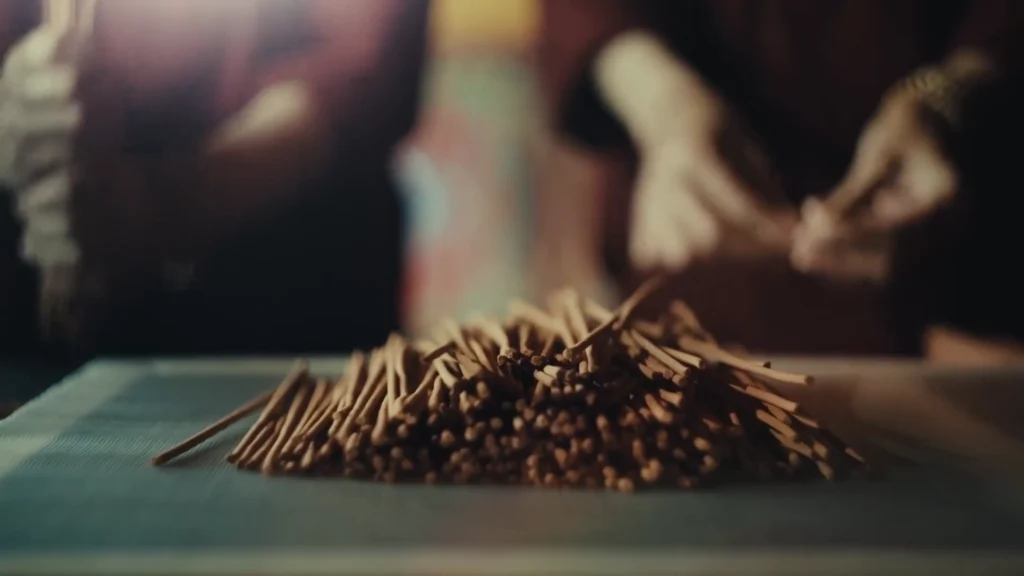
This special status of incense demands that its makers approach their craft with piety, compassion, reverence, and a profound sense of awe. In many Tibetan monasteries, the crafting of Tibetan incense itself constitutes an important spiritual discipline—a form of practice in its own right.
Does Tibetan incense have a bamboo core?
Unlike most Asian stick incense, Tibetan incense does not utilize a bamboo core. It is commonly extruded into strips using specific tools or hand-pressed into cones.
What ingredients are used in Tibetan incense?
Mainstream Tibetan incense generally uses Himalayan cypress as a base, with ingredients such as sandalwood, saffron, benzoin, nutmeg, clove, cardamom, and amomum added in fixed proportions.
Why is incense important in Buddhist ritual?
Incense is used as an offering to Buddhas and Bodhisattvas, and Buddhist texts frequently refer to its significance, virtue, and spiritual efficacy.
Why do different Tibetan incenses smell different?
Different formulas create different aromatic experiences. Tibetan incense is commonly medicinal and herbaceous in character, while individual formulas may express cypress, agarwood, cardamom, frankincense, and other notes.
Sources and Name Index
- Songtsen Gampo
- Tonmi Sambhoṭa
- Yutok Yönten Gönpo and The Four Medical Tantras
- Deumar Geshé Tendzin Püntsok, Shel gong and Shel phreng
- Susiddhikara Sūtra catalogue record
- The Vairocanābhisaṃbodhi Sutra
- The Larger Sutra on Amitāyus
- The Lotus Sūtra